
 Store
StoreGreater Philadelphia and Montgomery County, Pennsylvania · Energy Solutions
Campus HVAC Controls Modernization in Greater Philadelphia
Connect older buildings. Preserve useful equipment. Give the facilities team a controls system it can operate.
What this service does
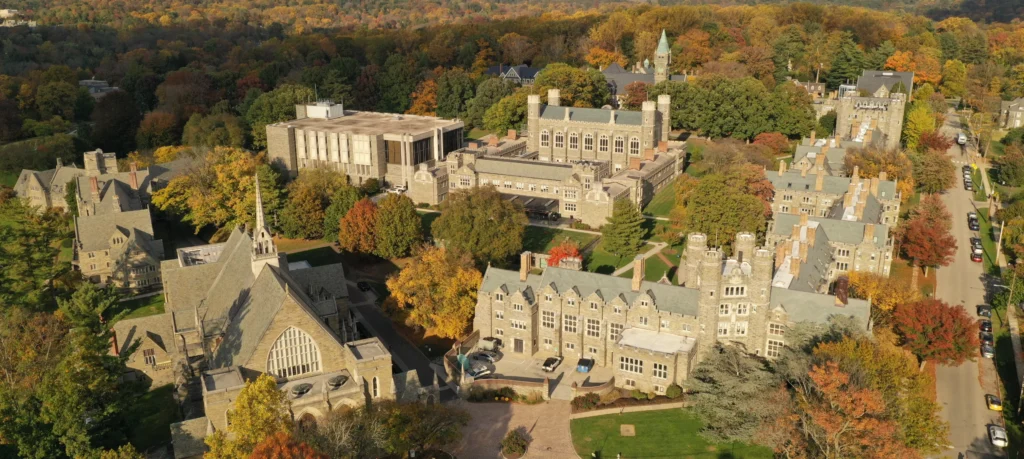
Campus HVAC controls modernization connects existing heating and cooling equipment to a maintainable building automation system. For Greater Philadelphia campuses, a phased approach can preserve compatible field devices while replacing unsupported controls. The Tustin Group provides controls integration, custom programming and commissioning, supported by documented work at Bryn Mawr College.
When this service is needed
A campus needs a controls assessment when repeated comfort complaints, offline controllers, unsupported software or conflicting schedules make routine operation difficult. The first decision is which equipment can remain useful and which controls create unacceptable operational risk. A new dashboard alone will not correct a failed valve, inaccurate sensor or undocumented sequence.
Who this is for: Campus facility directors, building engineers and institutional capital-planning teams.
Local conditions that shape the work
The Philadelphia region includes campuses where additions and renovations have left several generations of HVAC controls in service. Tustin’s Bryn Mawr College project is a documented local example: masonry construction and existing control points shaped a staged integration strategy. For another campus, academic calendars, residence-hall occupancy, IT access and capital budgets should determine the sequence of work. These are planning inputs to confirm during a site survey, not assumptions about every local building.
Local evidence: Bryn Mawr College project record.
Planning campus HVAC controls modernization
The following scope framework connects Tustin’s published capabilities with facility planning questions. The final service agreement and technical review determine the work for an individual site.
Inventory
Record controllers, sensors, actuators, network connections, licenses and equipment served.
Verify
Compare representative sensor readings and commanded actions with physical equipment response.
Prioritize
Separate failed devices, unsupported controls and operational changes that can be corrected in place.
Pilot
Migrate an agreed building or system and test alarms, schedules, trends and fallback operation.
Phase
Repeat the accepted scope around occupied periods, funding and coordinated IT access.
Hand over
Deliver point lists, sequences, backups, training and a named responsibility for ongoing support.
- 1. Room sensorMeasures a condition
- 2. ControllerApplies an approved sequence
- 3. Valve, damper or driveChanges equipment operation
- 4. Trend and field checkConfirms the intended result
Conceptual controls loop. Network type, point compatibility and safety interlocks must be verified for each campus.
| Condition | Operational concern | Next step |
|---|---|---|
| Repeated hot/cold complaints | Competing schedules, sensor error or a mechanical fault | Compare trends with field readings before rewriting logic. |
| Offline or unsupported controls | Limited visibility and difficult recovery | Document supportability and stage replacement around critical spaces. |
| Manual overrides remain active | Equipment may operate outside the intended sequence | Review the reason for each override and verify normal control before release. |
A facility planning example
Illustrative planning scenario, not a completed Tustin project: a Montgomery County campus has a renovated science building, older classrooms and occupied residence halls. The team pilots controls in a noncritical teaching wing, validates field points and alarms, then schedules later phases around occupancy. Critical spaces retain an agreed operating and recovery plan throughout each cutover.
Evidence behind the service
Customer and project evidence
The Bryn Mawr College case study documents a five-year modernization beginning in 2003 across a 50-building campus, retaining approximately 3,000 existing control points. College facilities personnel reported improved access to building conditions and faster investigation of complaints. These are historical, project-specific statements, not independently audited savings or a schedule promised for another campus.
Field and operator evidence
The same project record describes mechanics reviewing building conditions and operating parameters through the campus network. This is evidence of operator use, not a new interview with a Tustin technician. Tustin’s published energy-services scope also includes integration, programming and commissioning.
[FIELD EXPERT INPUT: A Tustin controls engineer should validate the proposed point-verification, fallback and handover scope, and approve a named, dated observation from a recent campus project.]

Prepare for the first service discussion
- Current controls drawings, point lists and sequence documents
- Software versions, licenses, backups and responsible IT contact
- Complaint history, trend exports and known overrides
- Academic and residence-hall schedules, access limits and critical spaces
Prevention and coordinated building services
After migration, assign an owner to review alarms, schedules and overrides. Retain an approved baseline and test changes before broad deployment. Mechanical service and controls work should share the same equipment inventory, so an actuator or airflow problem is not repeatedly treated as a software problem. DOE’s building re-tuning guidance supports using BAS data to identify operational improvements; it does not establish savings for a particular campus.
Local service coordination
Discuss a campus in Philadelphia, Montgomery County or the surrounding Pennsylvania service area through Tustin’s Pennsylvania office and service contacts. The project survey should confirm building access, equipment compatibility, service scope and implementation schedule.
Questions facility teams ask
Can existing sensors and control points stay?
Some can, after condition, accuracy, communications and supportability are verified. The Bryn Mawr record demonstrates retention in a specific historical project; it does not establish compatibility with every present-day device.
Does modernization require a complete campus shutdown?
Phased work may reduce the area affected at one time. Each cutover still needs a defined operating window, fallback plan and responsible operator. Confirm critical-space needs before programming or disconnecting controls.
What determines project cost?
Major factors include point count, controller condition, network work, licensing, integrations, occupied access, commissioning and operator training. A site-specific scope is needed before pricing or payback can be estimated.
How long does the process take?
Timing depends on the survey, hardware availability, network approvals, pilot acceptance and campus calendar. Separate planning, installation, testing and training milestones instead of treating delivery of hardware as completion.
When is replacement better than reprogramming?
Replacement may be appropriate when hardware is unreliable, unsupported or incompatible with the required architecture. Reprogramming may suit functioning systems with documented sequence or schedule problems. Field verification should precede that decision.
How will the team know the controls work?
Agree on acceptance checks before installation: sensor comparisons, command and response checks, alarm routing, schedule changes, trend review and operator access. Record unresolved items and retest them before handover.
Will a controls upgrade guarantee lower bills?
No. Energy results depend on equipment, weather, occupancy and operating practices. Establish a baseline and an agreed measurement method if savings are part of the business case.
Start with your facility’s operating needs
Send the site address, systems involved, current concern and preferred work window. The Tustin Group can review the appropriate service scope with your team.
Related services and project records
Source review: September 22, 2026. Scenarios are illustrative. Historical project results are labeled in context. No price, savings, response-time or compliance guarantee is made.