
 Store
Store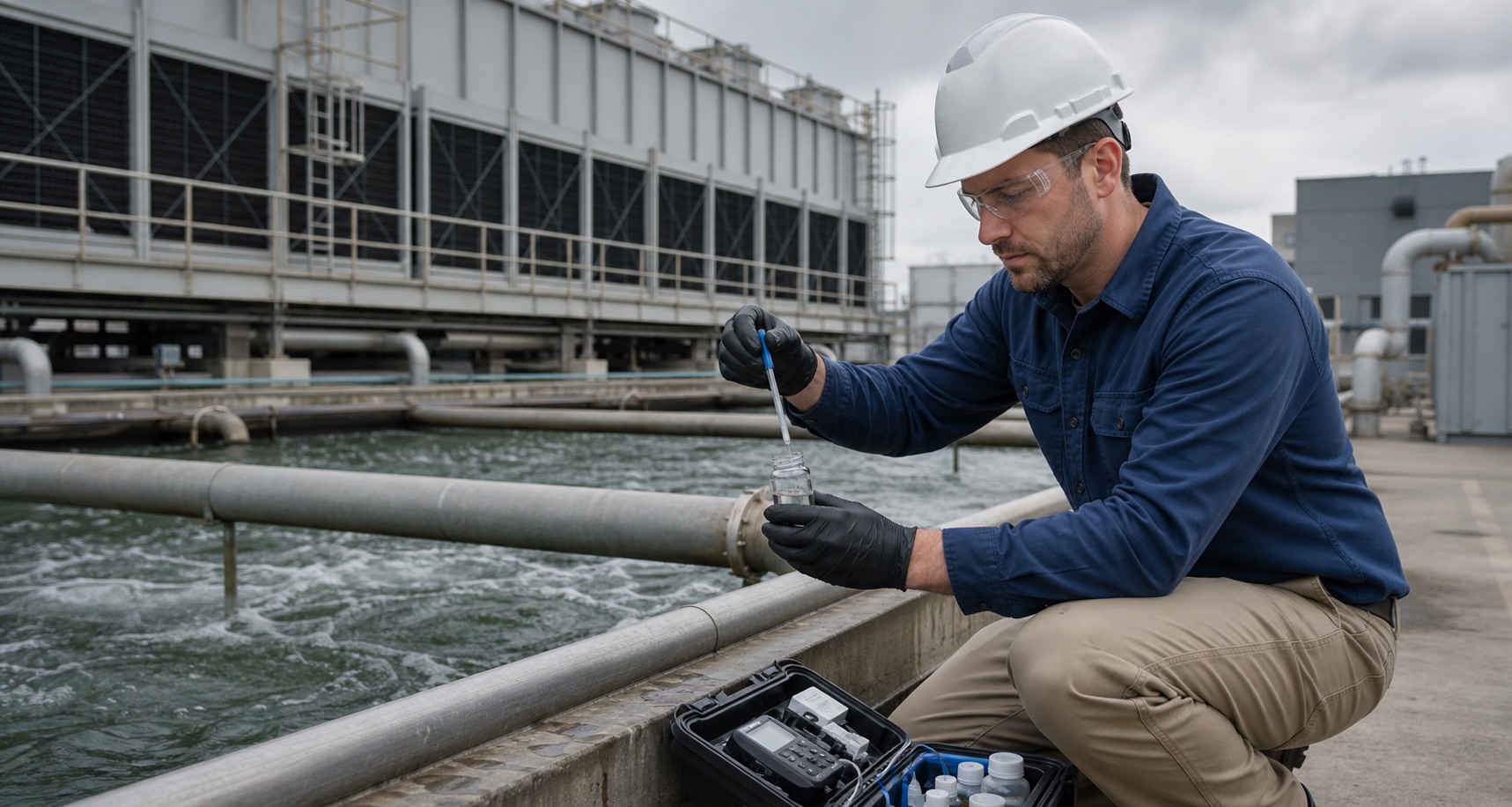
Cooling Tower Water Treatment: A Facility Manager’s Guide
Effective cooling tower water treatment is a managed program, not a one-time chemical choice. It coordinates system cleaning, scale and corrosion control, microbial control, blowdown, monitoring, corrective actions and records. The program should be designed for the tower, heat load, metallurgy, makeup-water quality, operating pattern and applicable health and environmental requirements.
Facility managers should expect clear control limits, defined test methods, assigned responsibilities and a response when results move outside the acceptable range. Because cooling towers can aerosolize water, water management also has a public-health dimension. Chemical selection, dosing and disinfection should be directed by qualified water-treatment and safety professionals.
What problems should cooling tower water treatment control?
Four concerns interact in an open recirculating system: scale, corrosion, fouling and microbiological activity. Scale can coat heat-transfer surfaces. Corrosion can damage metal and release deposits. Sediment and organic material can support biofilm. Microbial growth can affect system cleanliness and, in some circumstances, health risk.
Correcting only one problem can worsen another. For example, pushing cycles of concentration higher may reduce blowdown water but also increase dissolved solids and scaling pressure. An aggressive chemical adjustment may be incompatible with system metallurgy or discharge limitations. The operating target must balance water use, heat transfer, equipment protection and microbial control.
The Tustin Group describes chemical programs, water analysis, bacteria testing and system service within its commercial water solutions. Final recommendations require site data rather than a generic formula.
How do cycles of concentration affect tower operation?
As water evaporates, dissolved minerals remain in the recirculating water. Blowdown removes a portion of that concentrated water, while makeup water replaces evaporation, blowdown and other losses. “Cycles of concentration” compares the concentration of a relatively stable constituent in recirculating water with the makeup supply; conductivity is commonly used as an operating indicator.
Higher cycles can reduce blowdown and makeup demand, but the safe target depends on makeup chemistry, treatment, temperature and equipment. EPA WaterSense guidance recommends managing water chemistry and blowdown together rather than maximizing cycles without limits.
| Operating indicator | What it helps reveal | Possible follow-up |
|---|---|---|
| Conductivity | Dissolved-solids concentration and blowdown control | Verify controller, setpoint and valve operation |
| pH and alkalinity | Scaling, corrosion and disinfectant conditions | Review chemistry against program limits |
| Inhibitor or biocide residual | Whether treatment is present at the intended level | Check feed, calibration and demand |
| Makeup and blowdown meters | Water balance and unusual losses | Investigate leaks, overflow or control drift |
| Visual condition | Deposits, biofilm, debris, leaks or damaged parts | Clean, repair or escalate based on procedure |
A single reading rarely tells the whole story. Trend data, sampling location, calibration status and recent operating conditions all affect interpretation.
What belongs in a water management program?
CDC identifies an effective water management program as the primary strategy for controlling Legionella growth and spread. For cooling towers, the plan should identify the system team, process flow, hazardous conditions, control measures, acceptable limits, monitoring, corrective actions, verification and documentation. It should cover startup, normal operation, standby, seasonal shutdown and recommissioning.
Practical elements may include:
- An up-to-date system diagram and equipment inventory
- Cleaning and disinfection procedures
- Automated chemical feed and blowdown controls where appropriate
- Defined sampling locations, methods and frequencies
- Response steps for loss of feed, low residual, high conductivity or visible fouling
- Procedures for low-flow sections, shutdowns and restart
- Training, personal protective equipment and chemical handling requirements
- Records of test results, service, corrective actions and verification
Testing for Legionella, when used, should be integrated into a broader management strategy rather than treated as the only control. Sampling plans and response thresholds should be developed with qualified professionals and applicable public-health guidance.
How should chemical feed and blowdown controls be monitored?
Inspect the entire control loop: sensors, sample line, controller, pumps, tanks, tubing, interlocks and blowdown valve. Confirm that conductivity and chemical-feed equipment is calibrated and that alarms reach someone who can respond. Check that chemical tanks are labeled, contained and safely accessible.
Review data for abrupt changes rather than only checking whether the latest reading is “in range.” A stuck valve, failed makeup meter, empty chemical drum or fouled probe can create misleading results. Document manual overrides and return controls to their approved mode after service. Never mix treatment products or adjust dose without confirming compatibility, labeling and safety procedures.
When do cleaning and filtration become important?
Chemical treatment cannot compensate for accumulated dirt, leaves, process contamination or damaged tower components. Inspect basins, strainers, fill, drift eliminators, nozzles and accessible heat-transfer surfaces on an appropriate schedule. Clean and disinfect using a planned procedure that addresses worker exposure and aerosol control.
Side-stream filtration may help systems with suspended solids, fouling or difficult biological conditions. DOE notes that filtration does not remove dissolved particles, so it usually complements rather than replaces chemical treatment. Particle-size and suspended-solids data can help determine whether a filtration project fits the application.
How can facility teams evaluate a treatment provider?
Ask for a written program that connects each test to a control limit and corrective action. The proposal should specify service frequency, on-site testing, laboratory support, chemical delivery, equipment maintenance, reporting and emergency escalation. Confirm who owns controller calibration, cleaning, repairs, Legionella-related decisions and discharge compliance.
Useful reports show readings and trends, not just a checkbox that service occurred. They should identify out-of-range conditions, action taken, open recommendations and who was notified. The Tustin Group’s systems treated page includes cooling water treatment among its listed specialties; verify scope and service availability for the specific facility.
What should change during seasonal startup or shutdown?
Seasonal systems need written layup, startup and water-age controls. Before operation, inspect cleanliness and mechanical condition, complete required cleaning or disinfection, verify chemical feed and blowdown controls, fill with an approved water source and establish treatment before normal aerosol-producing operation. During shutdown, follow a wet or dry layup plan suited to the equipment and duration.
Weather and season length vary across Pennsylvania, New Jersey, Delaware, Maryland and Virginia. Check the Mid-Atlantic areas served, then confirm the relevant local team and discipline. A qualified provider should adapt timing to the actual system and climate rather than using a calendar alone.
How should a facility begin improving its program?
Collect the last year of service reports, laboratory results, makeup and blowdown data, cleaning records and corrective actions. Walk down the system with operations and the water-treatment provider. Reconcile the written diagram with installed equipment, identify missing instruments or access problems and prioritize conditions that affect microbial control, equipment integrity or reliable monitoring.
For a site-specific assessment, use The Tustin Group’s contact and service request page. Treatment decisions remain subject to water analysis, system inspection and applicable requirements.
Cooling Tower Water Treatment Planning Checklist
Use this checklist to prepare for a review with your water-treatment provider:
- Gather recent service reports, laboratory results and corrective-action records.
- Bring the equipment inventory and current system diagram.
- Review makeup-water and blowdown records with the provider.
- Confirm who owns testing, controller calibration, equipment service and follow-up.
- List unresolved maintenance recommendations and planned shutdown dates.
- Agree how service reports will identify open issues and the person responsible for each action.
Compare full-service and customized water management programs. For equipment inspection and seasonal planning, also read our cooling tower mechanical maintenance checklist.
What do facility managers ask most often?
Can higher cycles of concentration always save water?
Higher cycles can reduce blowdown, but only within limits supported by makeup chemistry, treatment and equipment. Pushing too far can increase scale or corrosion risk.
Does chemical treatment replace tower cleaning?
No. Debris, sediment, biofilm and damaged components require physical inspection and appropriate cleaning or repair.
Is Legionella testing the whole water management program?
No. Testing can support a program, but prevention also depends on control measures, monitoring, corrective action, cleaning and documentation.
Can one treatment program be copied to another building?
Not safely without review. Water quality, metallurgy, tower design, load, operating schedule and discharge conditions differ by site.
Which sources informed this guide?
Sources reviewed August 12, 2026: CDC, Controlling Legionella in Cooling Towers; EPA WaterSense, Best Management Practices; U.S. Department of Energy, Side-Stream Filtration for Cooling Towers. Follow chemical labels, safety procedures and applicable local requirements.
Leave a Reply