 Store
Store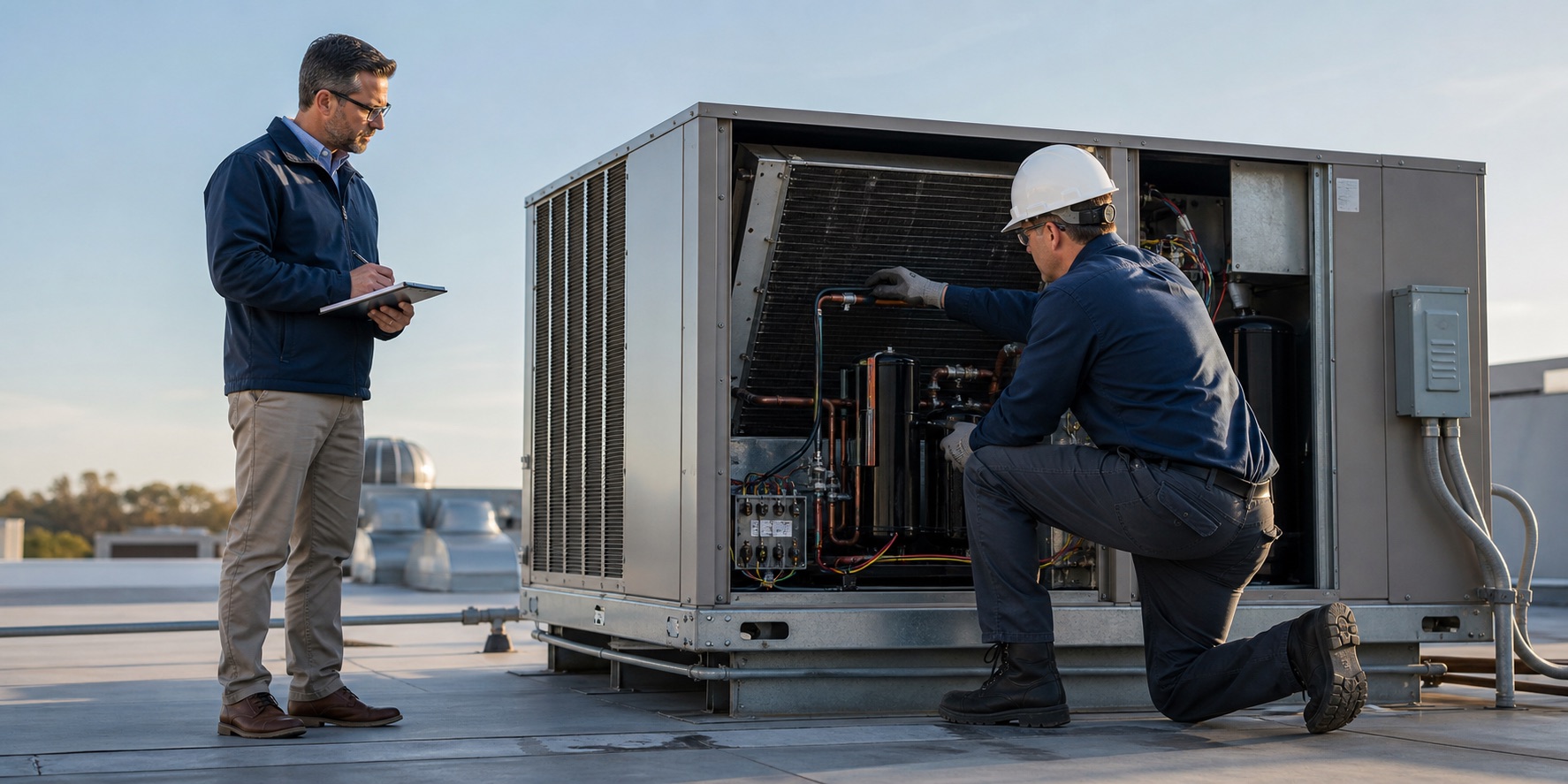
Commercial Rooftop Unit Repair or Replace: A Decision Guide
The commercial rooftop unit repair-or-replace decision should be based on total business risk, not age or one repair quote alone. Repair is often sensible when the unit is fundamentally sound, parts are obtainable, the failure is isolated, and performance can be restored reliably. Replacement becomes more compelling when failures repeat, critical components are deteriorating, comfort or ventilation remains unstable, refrigerant and parts support are constrained, or an unplanned outage would be costly.
Use a documented comparison that includes safety, present condition, repair scope, remaining service potential, energy performance, controls, refrigerant, tenant impact, roof logistics, and capital timing. A qualified HVAC professional should diagnose the equipment before management makes the financial decision.
When is repairing a commercial rooftop unit reasonable?
A repair can be the lower-risk choice when the cause is specific and the rest of the system has been evaluated. Examples may include a failed contactor, belt, sensor, actuator, ac blower motor, thermostat wiring issue, pro thermostat fault, or control component, depending on the unit’s overall condition. Most importantly, a repair recommendation should explain the confirmed failure, not simply replace parts until the symptom disappears.
In addition, ask whether the heat exchangers, compressors, coils, cabinet, electrical components, economizer, fans, ac drain line, drainage system, and controls were inspected as applicable. Review recent work orders for repeat faults. A technically successful repair can still be a poor business choice if another major failure is likely, parts require long lead times, or the unit cannot meet current occupancy and ventilation needs.
Finally, consistent maintenance history strengthens the case for repair because it provides evidence about how the asset has been operating. Facilities without reliable records may benefit from a broader condition assessment through a qualified commercial mechanical service resource.
When does rooftop unit replacement deserve priority?
Replacement deserves serious evaluation when several risk signals appear together:
- Repeated service calls, especially for different major components.
- Compressor, heat-exchanger, coil, cabinet, or structural deterioration.
- Persistent comfort, humidity, ventilation, or scheduling problems after proper service.
- Rising runtime or energy use that cannot be explained by weather, occupancy, or operating schedules.
- Difficult parts procurement or a refrigerant strategy that increases future service uncertainty.
- A unit that no longer matches the zone load, operating hours, tenant use, or control strategy.
- High consequence of failure, such as a critical room, healthcare function, production area, or densely occupied space.
Age is a screening factor, not an automatic verdict. DOE guidance notes that rooftop units often have a useful life measured in decades, but actual condition varies widely. Coastal exposure, poor drainage, short cycling, deferred maintenance, installation quality, operating hours, and roof access can move a unit far above or below a general age benchmark.
How should repair and replacement options be compared?
Build a side-by-side decision record. Avoid comparing only today’s repair invoice with the equipment purchase price.
| Decision factor | Repair question | Replacement question |
|---|---|---|
| Reliability | Does this repair address the root cause, and what else is likely to fail? | What warranty, redundancy, and support improve outage risk? |
| Operating cost | Will restored operation materially change runtime or efficiency? | What is the modeled energy impact under actual schedules and loads? |
| Refrigerant and parts | Are compliant service materials and critical parts reasonably available? | Which refrigerant, training, tools, and future support apply to the new unit? |
| Project cost | Include diagnosis, repair, rental cooling, overtime, and likely near-term work | Include equipment, curb adapter, crane, roof work, electrical, controls, permits, testing, and downtime |
| Operations | Can work occur without unacceptable disruption? | Can the changeout be phased around weather and occupancy? |
Use the same planning horizon for both options and show assumptions. Do not present estimated efficiency savings as guaranteed; weather, utility rates, controls, ventilation, occupancy, and maintenance all affect actual results.
What technical details can change the answer?
A replacement is rarely a simple like-for-like box swap. Confirm load and airflow requirements, curb dimensions, duct transitions, roof condition, structural capacity, electrical service, gas service, condensate routing, outside-air needs, controls integration, economizer sequence, smoke or fire interfaces, and safe service access. Required permits and code reviews vary by jurisdiction.
Refrigerant deserves a current, equipment-specific review. Federal technology-transition rules and product availability are changing, and requirements differ across equipment categories and dates. Confirm the proposed equipment and service strategy with the manufacturer, qualified contractor, and applicable EPA information rather than relying on a generic refrigerant claim.
Controls can also change the economics. A sound unit with weak scheduling, failed sensors, or poor economizer operation may need controls correction rather than wholesale replacement. Consider predictive maintenance and an energy-solutions assessment when the symptom spans multiple assets or zones.
How can a facility avoid an emergency replacement?
Create an RTU inventory with asset ID, location, capacity, age, refrigerant, major components, condition, repair history, criticality, roof constraints, and estimated replacement window. Rank units by both probability and consequence of failure. Update the ranking after major repairs and before peak heating or cooling seasons.
A planned replacement allows time for engineering, competitive procurement, utility coordination, permits, crane scheduling, controls integration, and commissioning. A mechanical service agreement can support asset history and planned maintenance, but scope varies; verify what is included for the property.
How does this apply across Mid-Atlantic facilities?
Mid-Atlantic portfolios must plan for humid summers, freezing conditions, storms, varied utility rates, and different state and local requirements. Standardize the decision worksheet, but keep load, code, roof, access, and operational assumptions site-specific. Check the areas served directory and confirm capabilities for the exact location and equipment before proceeding.
Interested in an HVAC Apprenticeship With The Tustin Group?
Commercial HVAC systems demand skilled technicians who understand diagnostics, safety, airflow, controls, maintenance, and long-term equipment performance. As a commercial HVAC company, The Tustin Group welcomes experienced HVAC professionals and candidates interested in an HVAC apprenticeship program with a team that supports commercial building performance.
In addition, current openings can help you take the next step toward a skilled-trades career. Explore opportunities with The Tustin Group and join a team that helps facilities run smarter, safer, and stronger.
What do facility managers ask about rooftop units?
Is a rooftop unit too old to repair after a certain year?
No single age decides it. Condition, failure history, parts, refrigerant, performance, risk, and project economics should be evaluated together.
Should one major compressor failure trigger replacement?
Not automatically. Compare the compressor repair with the condition of the remaining system, warranty, other major risks, downtime, and full replacement scope.
Can an efficiency rating predict actual savings?
No. Ratings help compare equipment, but actual results depend on sizing, installation, controls, ventilation, schedules, weather, utility rates, and maintenance.
Should all rooftop units in a portfolio be replaced at once?
Usually the better approach is risk-based phasing. Group projects when logistics or standardization create value, while prioritizing critical and deteriorated assets.
Which sources were reviewed on August 12, 2026?
- DOE guidance on proactive rooftop-unit replacement planning.
- DOE Better Buildings high-efficiency RTU replacement toolkit.
- EPA frequently asked questions on HFC transitions.
This guide is not an engineering design, code opinion, or financial guarantee. Obtain equipment-specific diagnosis and verify current federal, state, local, manufacturer, utility, and property requirements.
Leave a Reply